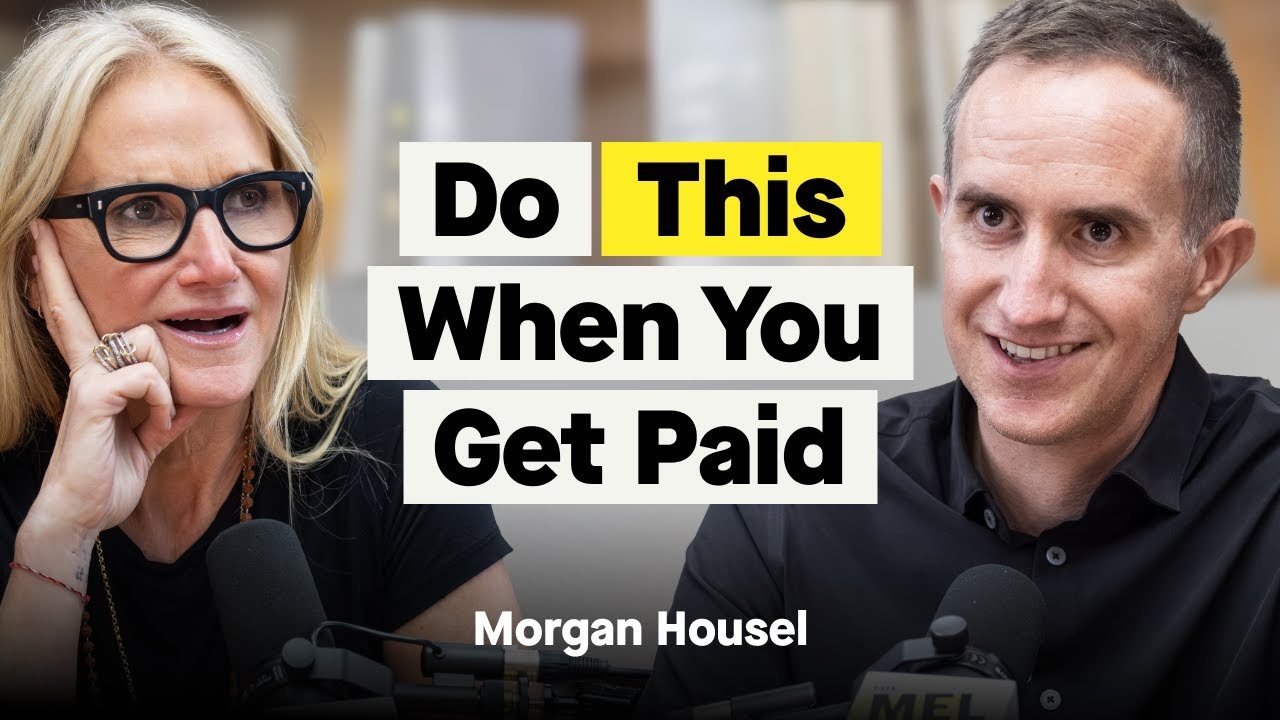
📺 Today’s recommended deep-dive video: https://www.youtube.com/watch?v=Ai4iNmW2A1c
Mastering the Mindset of Money: Why Your Behavior Matters More Than Your Bank Account
Most people believe getting rich requires a secret formula or elite education, but financial success is actually 99% behavior. Morgan Housel reveals how to stop the “expectations treadmill” and start using money as a tool for independence rather than a yardstick for status.
Core Question: How can shifting our psychological relationship with money lead to true financial independence?
Highlights
- Financial success is driven by behavioral discipline and patience rather than raw intelligence.
- Happiness is mathematically defined as the gap between your expectations and your reality.
- Every dollar saved is a “purchase” of future independence and psychological peace.
- The “Man in the Car” paradox proves that people admire the object, not the owner.
⏱️ Reading time: approx. 7 minutes · Saves you about 72 minutes vs. watching.
Want to take notes while watching? Click the image below and let AI Notebook capture the key points for you 👇

The Behavioral Blueprint
Intelligence vs. Temperament
Financial success is one of the few fields where an uneducated person with discipline can consistently outperform a Harvard MBA who lacks emotional control. You do not need to be a genius to do well with money; you simply need to master your impulses. This is impossible in fields like heart surgery or engineering, where specialized knowledge is the only barrier to entry, but money is governed by the “soft skills” of behavior and ego management.
Think of it this way: a person who didn’t graduate high school cannot perform open-heart surgery better than a trained surgeon, yet in the world of finance, someone with no formal training can retire a multi-millionaire simply by being patient and staying the course. This is because wealth isn’t about the secret formulas you know; it’s about the self-control you exert over your own desires and the ability to ignore the social pressure to keep up with neighbors. When you stop viewing finance as a math problem and start viewing it as a psychological one, the path to independence becomes much clearer.
Many people treat money as a complex equation to be solved with spreadsheets and high-speed algorithms. In reality, it is a psychological game played in the mind, where the winners are those who can master their own internal triggers and avoid the temptation of looking rich at the expense of being wealthy.

💡 Digging Deeper
Q: Why do smart people go broke?
A: Because intelligence doesn’t protect you from greed, envy, or the desire to impress strangers. High-IQ individuals often take excessive risks because they believe they can outsmart the market.
Q: Is financial success a choice?
A: While systemic factors exist, behavior is the variable most within an individual’s control. Anyone can decide to live slightly below their means and wait.
Q: What is the “kindergarten list” of money?
A: Save a little, live below your means, invest simply, and be extraordinarily patient. It is simple, though not always easy.
The Expectations Trap
The Gap of Happiness
Social media has hyper-charged the comparison trap, turning our local neighbors into a global feed of influencers and billionaires that we cannot realistically beat. This constant exposure creates an environment where our expectations for a “normal” life are inflated by the top 0.1% of the world’s earners.
When your expectations for a “good life” are dictated by a curated Instagram feed, the goalposts move faster than you can run. This creates a perpetual sense of falling behind, even when your objective quality of life is higher than that of previous generations who lived without air conditioning or modern medicine. To find contentment, you must learn to anchor your expectations to your own internal values rather than the status symbols of strangers who aren’t even looking at you. If expectations rise faster than income, you will feel poor regardless of how much you earn.
Morgan defines happiness as the literal distance between your expectations and the reality of your life. If you earn a million dollars but expected two, you feel like a failure; if you earn fifty thousand but expected forty, you feel successful. It is a relative game that can only be won by capping your desires.

💡 Digging Deeper
Q: What is the “Man in the Car” paradox?
A: When you see someone in a Ferrari, you don’t think they are cool; you imagine yourself in the car and think you would be cool. People admire the stuff, not the person.
Q: How do we stop the goalposts from moving?
A: By realizing that “enough” is a moving target. You have to consciously decide when your material needs are met so you can focus on independence.
Q: Does more money ever lead to happiness?
A: Only if it is used to buy time and autonomy. If more money just leads to more expensive “stuff,” the psychological benefit is zero.
Practical Tools for Independence
Savings as a Freedom Purchase
Every dollar you choose to save is not merely idle capital; it is a direct purchase of your future freedom and mental peace. Many people view savings as a “sacrifice” or delayed gratification, but Housel argues that saving is actually an immediate purchase of independence. That money sitting in the bank is a “down payment” on the ability to say no to a toxic boss or to weather a medical emergency without panic.
Compounding is the most powerful force in finance, but its results are heavily back-loaded toward the end of the journey. Take Warren Buffett as the primary example: over 99% of his massive net worth was accumulated after his 60th birthday because he stayed in the game for eight decades. Most people quit too early because they don’t see immediate results, missing the exponential growth that only comes to those with the stamina to stay in the market for decades. The secret to wealth isn’t picking the best stocks; it’s being “average” for an above-average period of time.
Automation is the bridge between intention and action. By setting up automatic transfers to savings, you remove the emotional burden of making a choice every month, effectively protecting your future self from your current impulses.

💡 Digging Deeper
Q: Is there a “right” amount to save?
A: The 10% rule is a great baseline. Even if it’s only $5 from a $50 tip, the habit of saving is more important than the initial amount.
Q: What is the best investment strategy?
A: Boring index funds. They allow you to own a piece of every major company without the need to “beat” the market, which most professionals fail to do anyway.
Q: Why should we view savings as an expense?
A: If you treat savings as “what’s left over,” there will never be anything left. Treat it like rent—a non-negotiable payment to your future self.
Key Takeaways
True wealth is not the cars you drive or the diamonds you wear; it is the “unspent” money that provides you with the autonomy to control your time. Independence is the highest dividend money pays. When you have the ability to wake up and say, “I can do whatever I want today,” you have reached a level of success that many billionaires—beholden to boards, public opinion, and high-burn lifestyles—never achieve.
Financial success requires a shift from seeking status to seeking utility. We spend money to impress people who are too busy worrying about their own status to notice us. By reducing the “ego” portion of your spending, you can increase your savings without decreasing your actual quality of life. The goal is to maximize for “sleeping well at night” rather than maximizing for the highest possible return on a spreadsheet.
Ultimately, the most important skill is patience. Whether you are dealing with a volatile stock market or a career setback, the ability to wait and keep your expectations in check is what separates those who build lasting wealth from those who cycle through periods of being “rich” and being broke. Money is a tool—use it to build a life of contentment, not a yardstick for comparison.
Q&A
Q1: What is the number one thing that keeps people broke?
A: Ignorance and the overwhelming urge to keep up with others. It isn’t a lack of intelligence; it’s the treadmill of rising expectations.
Q2: How does Morgan Housel define “wealthy” vs. “rich”?
A: “Rich” is current income and visible spending (cars, houses). “Wealthy” is the money you haven’t spent—the investments and savings that provide independence.
Q3: Why is Warren Buffett’s age important to his success?
A: Most of his wealth came after age 60. His secret wasn’t just being a good investor; it was being an investor for 75+ years. Time does the heavy lifting.
Q4: What should I do if I feel I’m “too far behind” to save?
A: Start with empathy and then shift your expectations. Any amount saved is a piece of your future gained back. Small, consistent changes are better than doing nothing out of despair.
Q5: Why are boring index funds recommended over hot stocks?
A: Because the simpler the investment, the more likely you are to stick with it for 30 years. Complexity often leads to emotional selling during market dips.
Q6: How can I become more conscious of my spending?
A: Check your bank balance every single day. It only takes 10 seconds, but it removes the “ignorance” that leads to mindless overspending.
Q7: What is the ultimate goal of having money?
A: Independence. The ability to control your time and be beholden to no one is the most valuable thing money can buy.