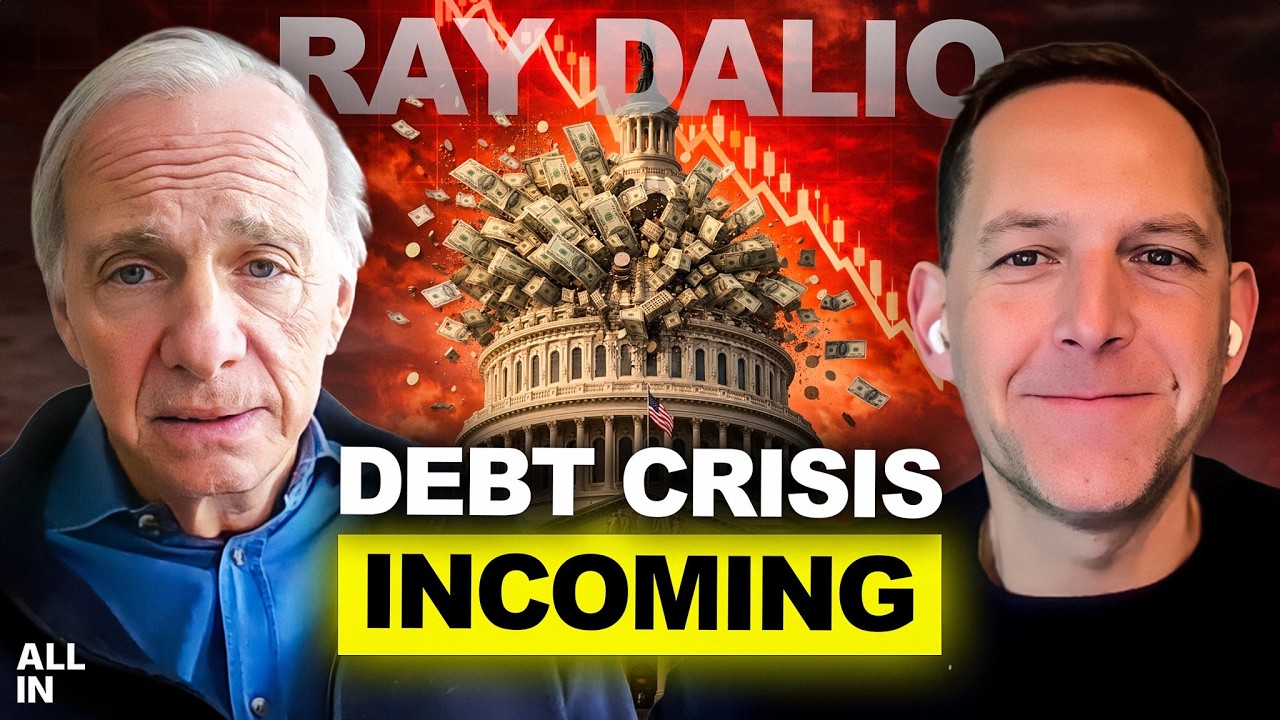
📺 Today’s recommended deep-dive video: https://www.youtube.com/watch?v=u-vMNzHgSHI
The Debt Plaque and the Great Cycle: Ray Dalio’s Roadmap for a Fractured World
Economic historian and legendary investor Ray Dalio returns to analyze the crumbling edges of the American financial order and the structural forces driving the current crisis. He examines why traditional fixes for government inefficiency are failing and what the historical transition into “Stage Five” means for your portfolio and the future of the republic.
Core Question: Can the United States navigate a debt-driven systemic collapse through fiscal discipline, or are social and geopolitical conflicts making a hard landing inevitable?
Highlights
- The mechanics of the 40% deficit and the “plaque” of interest payments in the economic circulatory system.
- Gold’s role as the premier “hard money” versus the speculative and controllable nature of Bitcoin.
- The failure of DOGE and why government inefficiency is a structural feature of democracy’s later stages.
- The three pillars of national success: quality education, internal civility, and the avoidance of war.
⏱️ Reading time: approx. 6 minutes · Saves you about 43 minutes vs. watching.
Want to take notes while watching? Click the image below and let AI Notebook capture the key points for you 👇

The Circulatory Crisis of US Debt
The Math of Decline
The United States is currently spending $7 trillion while taking in only $5 trillion, resulting in a staggering 40% deficit that threatens the very foundation of the dollar-denominated world order.
Dalio compares the credit system to the human circulatory system; when debt is used productively to generate income, the body thrives. However, when interest payments—which now account for half of the annual deficit—begin to outpace productivity, it acts like plaque in the arteries, squeezing out essential spending and forcing the government to roll over $9 trillion in maturing debt under increasingly risky conditions for foreign buyers.
Foreign creditors now view US debt with caution, not just because of the sheer volume, but because of the rising risk that sanctions or geopolitical conflicts might freeze their assets. This creates a supply-demand mismatch that could eventually force the Federal Reserve to expand its balance sheet once again to prevent a total freeze.

💡 Digging Deeper
Q: Why is the 3% deficit target so important?
A: It is a stabilization threshold; if the deficit to GDP ratio stays around 3%, the debt-to-income ratio remains manageable. Currently, we are at 6%, which is unsustainable.
Q: Is the Department of Government Efficiency (DOGE) a viable solution?
A: Making a massive government efficient quickly within a democracy is a “hell of a trick” because surgical cuts often cause enough social controversy to topple the government’s mandate before the benefits are realized.
Gold, Bitcoin, and the Search for Real Money
Why Central Banks Choose Gold
Gold has surged recently not because of retail speculation, but because central banks are rebalancing their portfolios away from fiat promises toward the second-largest reserve currency in the world. They recognize that while debt is a promise to pay, gold is the payment itself, independent of any third party’s creditworthiness.
Unlike Bitcoin, gold offers a level of privacy and historical permanence that central banks require to hedge against the risk of international sanctions or systemic collapse.
Bitcoin remains a relatively small, controllable market that tends to correlate highly with tech stocks rather than acting as a true store of value. Dalio suggests a prudent portfolio should hold 5-15% in gold as a diversifier; when the systemic “hits the fan,” gold acts as a non-correlated asset that preserves purchasing power while other instruments fail. The current shift toward hard assets is a signal that the “money of the mind” is losing ground to the “money of the earth.”

💡 Digging Deeper
Q: Why hasn’t Bitcoin performed like gold recently?
A: Bitcoin lacks privacy, is susceptible to monitoring, and is often sold off when tech investors get squeezed in other parts of their portfolios.
Q: What is the role of silver in this cycle?
A: Silver acts as a “residual commodity” and a speculative derivative of gold, historically perceived as money but currently more prone to volatile, speculative runs.
The Path Toward “Stage Five” Conflict
The Social and Productivity Gap
We are entering Stage Five of the internal cycle, characterized by irreconcilable differences where people value their specific causes more than the survival of the underlying system. This social friction makes government efficiency initiatives nearly impossible to execute; the political cost of surgical cuts often leads to controversy that threatens the stability of the leadership itself, preventing the very reforms needed to stabilize the 3% GDP deficit target.
To survive this phase, a nation must prioritize education, maintain civility among its citizens, and avoid the devastating costs of international and civil wars.
The productivity gap is perhaps the most dangerous element of the “K-shaped” economy, where 60% of the population struggles with low literacy levels while the top 1% focuses on AI-driven wealth. Without a workforce capable of competing in a profit-based system, the call for wealth taxes and socialist redistribution becomes politically inevitable, further driving capital away from productive investments.

💡 Digging Deeper
Q: Are we headed toward a choice between socialism and fascism?
A: This is the historical pattern when democracies fracture; the disorder often leads to a demand for a “strong leader” who can force order on the mob, regardless of ideology.
Q: How does AI factor into the geopolitical struggle with China?
A: China treats AI as a public utility (open source/low cost) to drive broad productivity, whereas the US treats it as a profit-based engine. This creates a systematic risk if their “free” tech competes with our “paid” tech.
Key Takeaways
The fundamental economics of the United States are mirroring the late-stage cycles of previous empires. With a 40% spending-to-income gap and interest payments acting as “plaque” in the financial system, the margin for error has evaporated. The historical remedy of printing money to solve debt creates a flight to “hard” assets like gold, which remains the only universally accepted reserve currency that isn’t someone else’s liability.
Success in this environment is not just about financial engineering; it requires a “three-pillar” foundation of education, civility, and peace. As the “K-shaped” economy widens the gap between the productive elite and the struggling majority, the risk of domestic “mob disorder” increases. Investors and citizens alike must recognize that we are in a transition from a multilateral world order to a power-based, confrontational one where independence and productivity are the only true safeguards.
Q&A
Q1: What is the “3% rule” Dalio refers to?
A: It is a bipartisan-supported goal to reduce the federal deficit to 3% of GDP through a combination of tax adjustments, spending cuts, and interest rate management to prevent the debt-to-income ratio from exploding.
Q2: Is the US workforce shrinking or just shifting?
A: While the federal workforce has seen recent declines, Dalio notes that the real issue is inefficiency. Many individuals are subsumed into government-adjacent roles that don’t drive actual economic productivity.
Q3: Is the AI market in a bubble?
A: Dalio distinguishes between the technology and the companies. While AI technology is transformative and will endure, many current companies may not survive as they fight for profits in an increasingly competitive, and potentially open-sourced, global market.
Q4: Why does Dalio prefer gold over Bitcoin as a “safe haven”?
A: Central banks will not hold Bitcoin because it lacks privacy and is controllable. Gold has a 500-year track record as a neutral reserve asset that cannot be printed or easily sanctioned.
Q5: What are the “Five Big Forces” driving the world today?
A: 1. The debt/money cycle. 2. Internal wealth/values gaps. 3. International great power conflict. 4. Disruptive technology (AI). 5. Acts of nature (pandemics/climate).
Q6: Can tariffs replace income tax?
A: Dalio is skeptical, noting that while tariffs are a valid revenue source and can help rebuild domestic manufacturing, they are regressive and unlikely to cover the total scale of US government spending requirements.
Q7: What is the “marshmallow test” for nations?
A: It is the choice between immediate gratification (current spending/debt) and long-term stability. Successful nations choose the “two marshmallows” by prioritizing future productivity over present consumption.