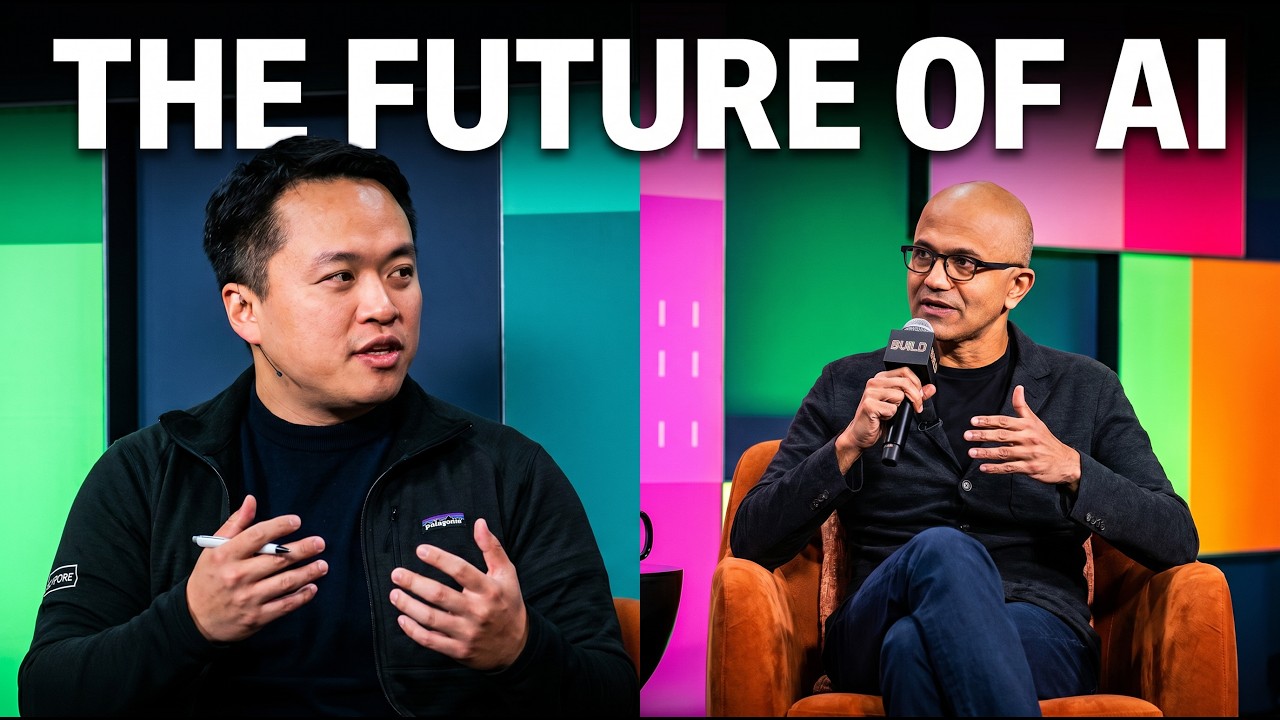
📺 Today’s recommended deep-dive video: https://www.youtube.com/watch?v=cFNI2FORAc0
The Token Economy: Satya Nadella on Why the “Harness” Is More Important Than the Model
Microsoft’s CEO joins the No Priors and Latent Space podcasts to discuss the transition from a “single model” focus to a comprehensive ecosystem strategy. He argues that the future of enterprise value lies not in generic intelligence, but in the private evaluations and specialized “harnesses” that allow companies to hill-climb toward frontier performance.
Core Question: How can organizations transition from being mere AI users to first-class participants who own their intelligence and “meta-work” workflows?
Highlights
- Ecosystem over Model: A platform is defined by the value created above it, not just the capabilities captured within it.
- The Hill-Climbing Scaffold: Small models (like 5B parameters) can achieve frontier performance when wrapped in high-quality private data and “traces.”
- The End of “Typing”: We are moving from a world of manual knowledge work to a “meta-work” era where humans manage agentic systems.
- IP on the Balance Sheet: Private evaluations and the “tacit knowledge” captured in agent traces will become a company’s most valuable asset.
⏱️ Reading time: approx. 6 minutes · Saves you about 35 minutes vs. watching.
Want to take notes while watching? Click the image below and let AI Notebook capture the key points for you 👇

The Ecosystem Play: Beyond the Single Model
Defining the Platform Shift
Satya Nadella views the current AI shift not as a race between models, but as an ecosystem play where success is defined by the value created above the platform.
Microsoft has navigated four major platform shifts, and Nadella’s primary reflection is that a platform’s true worth lies in its ability to enable first-class participation from every company. Whether an AI-native startup or a legacy enterprise, the goal is to provide a recipe—the stack, tooling, and lineage—that allows them to point to intelligence they created themselves rather than just using a generic service.
This represents a departure from the “single model” paradigm, focusing instead on how organizations can build hill-climbing scaffolds around smaller, efficient models to achieve frontier-level performance in specific domains.

💡 Digging Deeper
Q: Why emphasize small models (5B) over massive frontier models?
A: Because a small, efficient model can reach frontier performance if you build a high-quality “scaffold” of specialized data and traces around it, making it more cost-effective for specific tasks.
Q: What is a “clean lineage” in model training?
A: It is the process of using high-quality data and rigorous ablation to ensure a model performs reliably in practice, rather than just gaming popular benchmarks.
Q: How does Microsoft define a successful platform?
A: Success is measured by the delta between the value the platform captures and the (much larger) value created by the developers and companies building on top of it.
The Harness and the Context Layer
Building the Scaffolding for Agents
The industry might have underestimated the real-world complexity of deployment compared to the simple logic of scaling laws.
Delivering measurable value requires moving beyond “token maxing” and focusing on how those tokens execute specific, unique tasks that an organization values. This requires a robust context layer—the “harness”—that allows plans to execute efficiently across multimodal tools. In Nadella’s view, the magic isn’t just in the model; it’s in the amount of work done to prep the context layer so that an agent’s plan can execute in the most efficient, token-saving way.
The “harness” is the environment that provides an agent with its tools, memory, and identity, acting as the bridge between raw intelligence and a completed workflow.

💡 Digging Deeper
Q: Is the chat interface the final form of AI?
A: No; for complex tasks like coding, we need a “canvas” and an “ADE” (Agent Development Environment) to manage the cognitive load of dozens of simultaneous agent sessions.
Q: What is the “glue work” mentioned in the transcript?
A: It refers to the human capital spent coordinating between different tasks and departments—work that is now being augmented by long-running, durable agents.
Q: Can different models be swapped within the same harness?
A: Yes; the goal is to have an open harness where a company can switch from Model A to Model B while maintaining their private evaluations and “hill-climbing” progress.
Re-litigating SaaS and Business Models
Unbundling the Traditional Stack
In the agentic world, SaaS is being re-litigated as the traditional stack of data models, business logic, and UI undergoes unbundling and re-bundling.
Nadella points to “Work IQ” as a transformative shift, where previously captive databases like email and transcripts become accessible to agents that can then suggest code changes or draft project plans based on design meeting histories. This 10x value opportunity necessitates a move away from rigid, permanent business models toward a flexible mix of per-user, consumption-based, and outcome-oriented pricing.
A company’s private evaluations and the traces of its agents may soon become the most significant intellectual property on its balance sheet.

💡 Digging Deeper
Q: Will AI end the need for traditional software?
A: Unlikely; while AI can generate software, the underlying data models (like a general ledger) need to remain stable and robust.
Q: How should companies choose between “buying” and “building” AI?
A: Organizations should acquire software if the marginal cost of building and maintaining a custom solution—including the “token burn” for security fixes—is higher.
Q: Why do customers sometimes reject outcome-based pricing?
A: While they like the idea initially, once the value is delivered, many prefer to switch back to per-user or consumption pricing to avoid “giving away royalty” on their success.
The Future of Work: Meta-Cognition and Community
From Typists to System Managers
The “meta-work” era isn’t about having four billion typists; it’s about four billion creators using token capital to amplify their intent.
Nadella describes “meta-work” as the process of building agentic systems to do the work, rather than doing the manual tasks yourself. This evolution allows generalist knowledge workers to exert massive leverage, turning a single person into a full-stack builder who can bridge the gap between ideation and production. This shift is already happening internally at Microsoft, where networking teams use an agent named “Miles” to manage fiber operations.
The unprecedented scale of Microsoft’s data center buildout requires a new level of community partnership and environmental responsibility to maintain societal “permission.”

💡 Digging Deeper
Q: What is the “Chief of Staff autopilot”?
A: A long-running agent Nadella built for himself that monitors his work context, stores memory, and can publish updates to his team.
Q: How does AI change engineering roles?
A: We are seeing the rise of the “Full Stack Builder”—a generalist who uses AI to handle front-end, back-end, and design simultaneously.
Q: How can data centers benefit local communities?
A: Through significant tax base increases, job creation during and after construction, and investments in the local energy grid and water replenishment.
Key Takeaways
The shift toward an AI-driven economy is fundamentally about agency. Satya Nadella emphasizes that the “impossible” is becoming “possible” because the barrier between having an idea and executing it is dissolving. Whether it’s a CEO building a custom chief-of-staff agent or a networking team automating fiber repairs, the focus is moving from performing tasks to designing the systems that perform them. This “meta-work” requires a new set of skills: the ability to define private evaluations, manage agentic traces, and orchestrate complex harnesses.
Ultimately, the durability of a company in this new era depends on its ability to capture tacit knowledge. Historically, this knowledge lived only in the minds of veteran employees and couldn’t be placed on a balance sheet. Today, through the traces left by agents and the refinement of private models, that expertise can be codified and compounded. As long as the industry delivers tangible benefits to communities and maintains a stable “token economy,” we are entering a golden age for “idea people” with the ambition to reconceptualize what is possible.
Q&A
Q1: How does Microsoft’s training strategy differ from others?
A1: Microsoft focuses on “clean lineage” and the “cognitive core,” enabling smaller models to “hill-climb” to frontier performance using specialized scaffolds rather than just chasing general-purpose benchmarks.
Q2: What is the most important “IP” for a company today?
A2: A company’s “private evals”—the internal metrics and datasets used to train and validate their specific AI agents—are becoming their most critical intellectual property.
Q3: Is per-user pricing dead?
A3: No; it provides budget certainty that many customers crave. However, it will likely be supplemented by consumption-based meters as the use of high-intensity agents grows.
Q4: How does AI change the “SaaS” model?
A4: AI unbundles SaaS by making the underlying data (like emails or logs) accessible to agents, allowing for new “Work IQ” workflows that weren’t possible when data was trapped in specific apps.
Q5: What is “meta-work”?
A5: It is the shift from doing a task (like networking) to building and managing the agentic system that performs that task.
Q6: What role do communities play in the AI buildout?
A6: Communities provide the “permission” for hyperscale data centers. In exchange, tech companies must provide real value: better energy grids, water replenishment, and a strong local tax base.
Q7: Will AI replace engineers?
A7: It won’t replace them, but it will redefine roles. We will see more “Full Stack Builders” (generalists) and highly specialized infrastructure/science roles focused on reward learning and distributed systems.