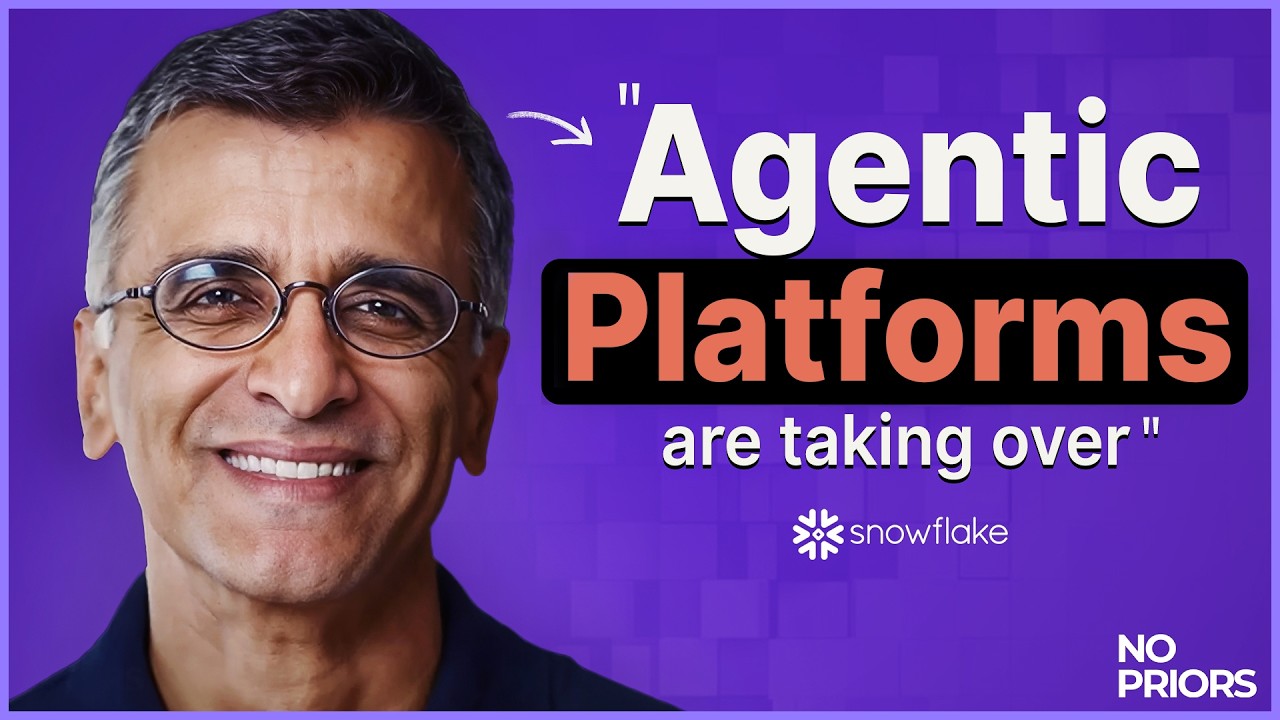
📺 Today’s recommended deep-dive video: https://www.youtube.com/watch?v=UIDMhKgpqkg
The Agentic Shift: Sridhar Ramaswami on Snowflake’s AI Transformation
Sridhar Ramaswami reflects on his first 18 months as Snowflake’s CEO, detailing the company’s rapid transformation from a cloud data warehouse to an “AI Data Cloud.” He breaks down why the era of static dashboards is ending and how “opinionated” agentic systems will redefine enterprise productivity.
Core Question: How can a data giant successfully pivot to an agentic AI strategy while maintaining the trust and reliability required by the Fortune 2000?
Highlights
- The shift from building foundation models to creating an “opinionated” agentic platform.
- Why internal tools like “Raven” serve as the blueprint for high-ROI enterprise AI.
- Navigating the “Elephant” ecosystem: Partnerships with Microsoft, SAP, and the hyperscalers.
- The evolution of the advertising model and why citations are the new currency of trust.
⏱️ Reading time: approx. 6 minutes · Saves you about 36 minutes vs. watching.
Want to take notes while watching? Click the image below and let AI Notebook capture the key points for you 👇

The AI Pivot: Transforming Snowflake’s DNA
Reorganizing for Speed
When Sridhar took the helm, he inherited a company with legendary product-market fit but a structure that had grown overly specialized and slow. The distance between engineering and the end customer had stretched across nearly ten layers of management, an organizational bloat that simply cannot survive in the hyper-fluid world of generative AI.
Speed wins, and for Sridhar, the primary goal was collapsing those layers to enable faster iteration cycles that prioritize accountability over carefully laid, long-term strategies.
The transformation wasn’t just organizational; it was existential. Snowflake briefly considered building its own foundation models before realizing that competing with capital-heavy labs like OpenAI was a losing game. Instead, they pivoted to become the “AI Data Cloud.” By focusing on how AI accelerates the data already residing in Snowflake—leveraging the trust of Fortune 2000 customers—the company found its unique sweet spot between the foundation labs and the cloud service providers.

💡 Digging Deeper
Q: Why did Snowflake move away from building its own foundation models?
A: The capital requirements to compete with OpenAI or Anthropic are massive, and Snowflake realized its true value lies in how AI interacts with a customer’s proprietary data, not the underlying model itself.
Q: How did you change the leadership structure to move faster?
A: We implemented a “pod” or “war room” model where product, engineering, and go-to-market teams work in tight, accountable groups to iterate on new features like Cortex in weeks rather than quarters.
Q: What was the biggest internal hurdle to this change?
A: Moving from a “data team” focus to an “every employee” focus required retooling our identity provider integrations and rethinking our pricing to a consumption-based model that encourages broad adoption.
Snowflake Intelligence and the Agentic Era
Beyond the Static Dashboard
Dashboards are static, 2D views of a complex reality that rarely provide the “why” behind the “what.” Sridhar believes the future of data consumption isn’t a new chart, but an interactive, agentic interface accessible to every employee, regardless of their ability to write SQL.
Snowflake Intelligence (SI) represents a shift toward an “opinionated” agentic platform. Unlike general-purpose agents from CSPs that promise to do everything and end up doing nothing well, SI focuses specifically on extracting value from data. It moves away from the “YOLO AI” mentality of unpredictable outputs, emphasizing a software engineering approach where every AI interaction is backed by rigorous evaluation loops to ensure enterprise-grade reliability and trust.
A prime example is “Raven,” Snowflake’s internal sales assistant. Instead of hunting through Salesforce or Tableau, a rep can simply ask Raven about a customer’s recent contract, consumption trends, and outstanding support tickets, getting a holistic view in seconds rather than hours of manual data stitching.

The New Game Theory of Tech Giants
Building on the Shoulders of Elephants
Sridhar views the tech landscape through the lens of game theory, having spent time at Google and Neva before Snowflake. Building on top of cloud service providers (CSPs) like AWS or Azure requires a delicate balance of competition and collaboration, as these “elephants” possess infinite budgets and an insatiable appetite for data ownership.
Defensibility is not a strategy you write down; it is a daily practice of building faster than the hyperscalers can copy you.
The partnership strategy has matured into a “1+1=3” mentality. By collaborating with SAP for bidirectional data sharing or deepening ties with Microsoft despite competing with their Fabric product, Snowflake positions itself as the independent data layer. This independence is their greatest asset; it allows them to offer a higher level of abstraction and simplicity that integrated CSP services often lack, providing customers with a unified experience that spans multiple clouds effortlessly.

💡 Digging Deeper
Q: How do you compete with CSPs who have infinite budgets?
A: By staying at a higher level of abstraction. CSPs sell raw compute and storage; we sell integrated simplicity and the ability to share data across different cloud environments.
Q: What is the core of the SAP partnership?
A: Bidirectional data sharing. It’s about making SAP data accessible for AI and analytics within Snowflake without the friction of traditional ETL processes.
Q: Is any software company safe right now?
A: No. Every CEO feels threatened because AI changes the technical environment so fluidly. Defensibility must be earned every day through innovation, not just market position.
The ROI of Applied AI and Search
Stack-Ranking Value
For enterprises seeking immediate ROI, Sridhar stack-ranks coding agents and customer support as the low-hanging fruit. Coding agents demystify technology, allowing more people to build within the ecosystem, while support agents leverage existing repositories of human knowledge to provide seamless, voice-and-text-enabled answers. However, he warns against obsessing over massive $100-million bets too early. The key is taking “many shots on goal,” iterating small projects at a thousand dollars a time until value is proven.
AI should not be a “maximalist” endeavor. A truly smart system knows when to use a tool, like a search API or a Python script, rather than hallucinating a math problem.
Regarding the future of the internet’s business model, Sridhar remains bullish on advertising but expects a reinvention. As chat interfaces replace the “ten blue links,” the premium on citations and sourcing will grow. Preserving consumer agency—knowing what is an ad and what is an objective answer—will become the defining challenge of the next digital decade.

Key Takeaways
Snowflake’s transition under Sridhar Ramaswami highlights a broader shift in the enterprise: data is no longer a passive asset for dashboards but an active fuel for agents. By organizing into accountable “pods” and prioritizing speed, Snowflake is betting that an opinionated, data-centric AI platform will outperform generic CSP offerings. The shift from “Data Cloud” to “AI Data Cloud” is less about the models themselves and more about the integration of those models into the workflows of every employee.
The path to AI ROI is paved with small, iterative shots on goal rather than monolithic projects. Whether it is deploying coding agents to solution engineers or creating internal sales assistants like Raven, the goal is to drastically reduce the “time to value.” Sridhar’s philosophy emphasizes that defensibility is built through constant innovation and that even the largest software companies must now earn their place in the sun every single day in this new fluid reality.
Q&A
Q1: What was the primary motivation for the CEO transition from Frank Slootman to you?
A: Frank presciently felt we were entering a tumultuous product cycle driven by AI and wanted a product-first leader to guide the company through that transformation.
Q2: How does Snowflake Intelligence differ from a general-purpose agent?
A: It is “opinionated.” It focuses specifically on data-driven tasks and insights rather than trying to be a general-purpose assistant that handles everything from travel booking to HR.
Q3: What is the “Raven” project?
A: It is our internal sales data assistant that combines CRM data, consumption metrics, and support history into a single interactive interface for our sales team.
Q4: Where should companies start their AI journey for the best ROI?
A: Coding agents and customer support bots. These areas have clear repositories of knowledge and measurable efficiency gains.
Q5: Do you think LLMs will replace traditional search and indexing?
A: No. A smart system uses the best tool for the job. Search APIs provide primary sources and citations that LLMs cannot yet internalize perfectly, and citations are key to trust.
Q6: How do you handle “subscription fatigue” with new AI products?
A: We are sticking to a consumption-based model. You pay for what you use, which allows companies to experiment with AI “a thousand bucks at a time” rather than committing to massive upfront licenses.
Q7: What did your time at Google teach you about AI today?
A: It taught me the power of feedback loops. Google became great because of the click-data feedback loop, and modern AI systems need similar evaluation loops to improve over time.