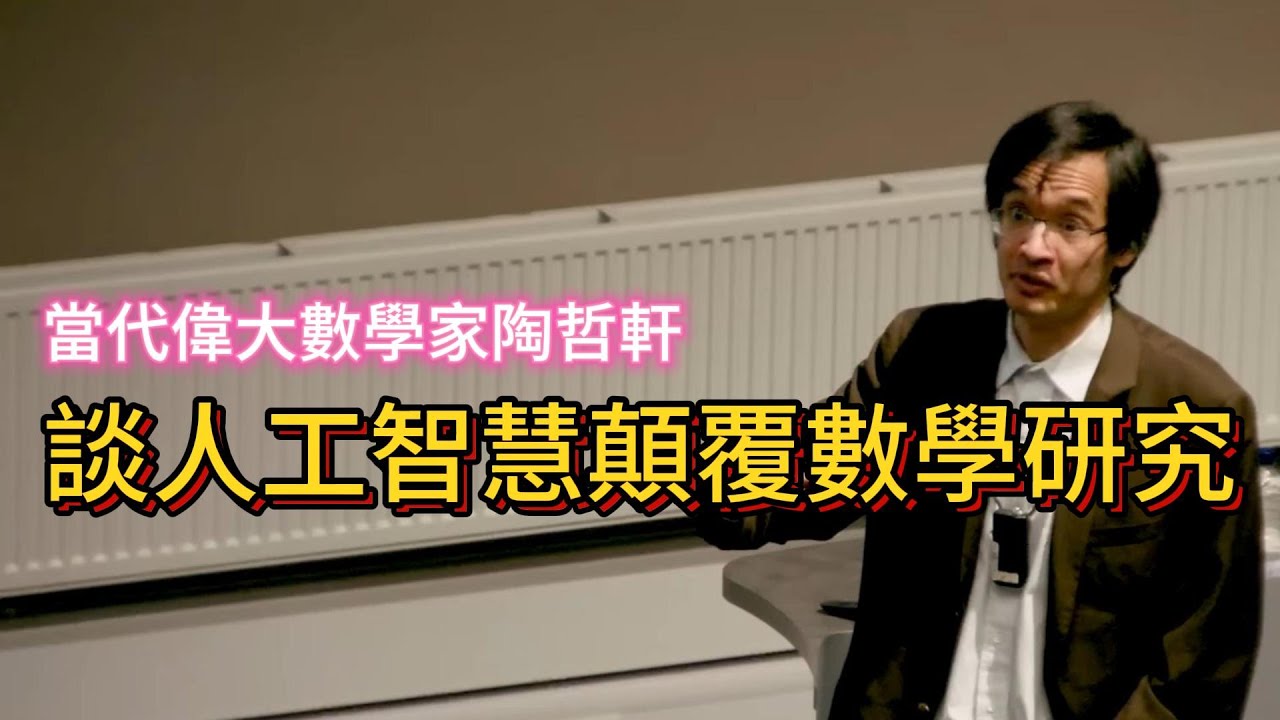
📺 Today’s recommended deep-dive video: https://www.youtube.com/watch?v=HJOLVsufLfU
Beyond the Abacus: Terence Tao on the AI Revolution in Mathematics
Field Medalist and former IMO prodigy Terence Tao explores the shifting landscape of mathematical research in the age of artificial intelligence. From the historical clusters of “human computers” to modern decentralized proofs verified by the Lean programming language, the tools of discovery are evolving rapidly.
Core Question: How is the transition from simple calculation to machine-assisted reasoning redefining the way mathematicians collaborate and solve complex problems?
Highlights
- The term “computer” was originally a job description for human calculators, measured in units like the “kilogirl hour.”
- Modern proof assistants like Lean allow dozens of mathematicians to collaborate on a single theorem through shared “blueprints.”
- Machine learning is uncovering hidden correlations between disparate fields, such as geometry and knot theory, that humans missed for decades.
- Large Language Models currently act as “muses” that suggest unexpected techniques, even if they still struggle with basic arithmetic logic.
⏱️ Reading time: approx. 8 minutes · Saves you about 49 minutes vs. watching.
Want to take notes while watching? Click the image below and let AI Notebook capture the key points for you 👇

The Deep History of Mathematical Machines
From Human Clusters to Digital Databases
Mathematics has always relied on external tools to augment the inherent limits of the human mind, spanning thousands of years of technological evolution.
For centuries, the word “computer” referred not to a machine, but to a professional—often women—who performed tedious calculations for ballistics or astronomical tables. During the World Wars, computational power was measured in “kilogirl hours,” representing the work of one thousand human computers working for sixty minutes. This manual labor was essential for creating the logarithmic and prime number tables that mathematicians like Gauss used to conjecture the Prime Number Theorem long before they could prove it.
Today, these physical tables have evolved into massive digital archives like the Online Encyclopedia of Integer Sequences (OEIS). When a researcher discovers a sequence of numbers in a new problem, they can query the OEIS to find if another mathematician encountered the same sequence in a completely unrelated field. This connection acts as a “digital bridge,” revealing deep, structural links between different mathematical universes that would otherwise remain isolated.

💡 Digging Deeper
Q: Why was floating-point arithmetic invented?
A: Hendrik Lorentz developed it to help human computers model fluid flow for Dutch dikes, ensuring different people could calculate numbers of varying magnitudes consistently.
Q: How did tables lead to the Prime Number Theorem?
A: Gauss and Legendre spent years manually calculating prime number distributions in large tables, allowing them to spot the logarithmic pattern that defined the theorem long before a formal proof existed in 1907.
The Rise of the Proof Assistant
Verification in the Era of Complexity
As mathematical proofs grow to hundreds of pages, the traditional peer-review process is reaching a breaking point of human reliability.
The 1998 proof of the Kepler Conjecture involved 250 pages of notes and three gigabytes of data, leaving a panel of twelve referees only 99% certain of its correctness after four years of study. This “trust gap” led to the Flyspeck project, a 12-year effort to formalize the proof into machine-code that could be verified down to the basic axioms of logic. Such projects have transitioned from being eccentric hobbies to foundational necessities for cutting-edge research.
Modern languages like Lean are changing the social fabric of the field. By creating a “blueprint” that breaks a massive theorem into hundreds of small, manageable tasks, researchers can now collaborate in decentralized groups of twenty or more. In Tao’s own work on the PFR conjecture, this allowed a team of experts and programmers to complete a formalization in just three weeks. The compiler acts as a rigid arbiter of truth; if the code doesn’t compile, the proof isn’t accepted, allowing strangers to collaborate without needing to manually verify each other’s work.

💡 Digging Deeper
Q: What is a “blueprint” in formal mathematics?
A: It is a hierarchical map that decomposes a high-level proof into tiny logical steps, allowing multiple people to work on different parts of the problem simultaneously.
Q: Does formalizing a proof take longer than writing it?
A: Currently, yes—it takes about ten times longer to write a proof in a language like Lean than it does to write it on paper, but it is much easier to modify or update later.
AI as a Muse and Discovery Tool
Machine Learning and Large Language Models
Machine learning is not just for crunching numbers; it is now being used to generate intuition and predict connections that humans simply cannot see.
In knot theory, researchers recently used neural networks to predict the “signature” of a knot by looking at its geometric invariants. While the AI was a black box, a technique called “saliency analysis” allowed humans to see which specific inputs the AI was focusing on. By observing the AI’s preferences, mathematicians identified a previously unknown relationship between hyperbolic geometry and topology, which they were then able to prove using traditional methods.
Large Language Models (LLMs) like GPT-4 are beginning to act as a “mathematical muse” for researchers. While these models are notoriously bad at simple arithmetic—often hallucinating results before correcting themselves—they are surprisingly good at suggesting high-level strategies. Tao notes that an LLM once suggested using “generating functions” for a problem he was stuck on; while it didn’t solve the problem itself, the hint provided the exact spark needed for the human to find the solution.

💡 Digging Deeper
Q: Can GPT-4 solve IMO problems?
A: It can solve specific, simplified examples, but its success rate remains very low (around 1%) when faced with the full breadth of competition-level mathematics.
Q: How do AI solvers handle the “hallucination” problem?
A: Researchers are connecting LLMs to external tools like Python or Lean; if the AI’s suggested proof fails to compile or run, the error message is sent back to the AI to force a correction.
Key Takeaways
We are entering an era of “scaled mathematics.” For centuries, discovery was limited by the speed at which a single genius could think or a small group could communicate. The integration of proof assistants and AI allows for the exploration of problem spaces on a massive scale—where a researcher might test a technique against a thousand similar problems simultaneously rather than laboring over one for years.
The role of the mathematician is shifting from a solo practitioner to something more akin to an orchestrator. While the “old-fashioned” way of proving theorems remains essential for guiding the machines, the ability to manage decentralized teams and utilize AI-generated conjectures will define the next generation of breakthroughs. The future of the field lies in the synergy between human intuition and the uncompromising logical rigor of silicon.
Q&A
Q1: How does Terence Tao view his early start at university?
A1: He views it as a personal journey facilitated by supportive parents and advisors, emphasizing that it isn’t a “race” and depends entirely on when an individual is ready.
Q2: What was the “Pythagorean triple problem” mentioned?
A2: It was a combinatorics problem solved by a SAT solver that produced an 86-gigabyte compressed proof—the longest in history at the time—which no human could ever read in its entirety.
Q3: What is “saliency analysis” in the context of AI math?
A3: It is a method of probing a neural network to see which specific inputs (variables) are most influential in its decision-making, helping humans identify where to look for new conjectures.
Q4: Will AI replace mathematicians?
A4: Tao suggests AI will be a “transformative assistant” rather than a replacement, helping mathematicians explore wider spaces and verify results that are too complex for human peer review.
Q5: What is Tao’s Erdős number?
A5: His Erdős number is two.
Q6: How does Lean help with collaborative projects?
A6: It removes the need for interpersonal trust; since the software automatically verifies every line of code against mathematical axioms, collaborators can be certain that a submitted piece of the proof is correct.
Q7: What is the main difference between competition math and research math?
A7: Competition math involves solving a set problem in a fixed time, while research math involves months of work where the goal or the problem itself may change if it proves unsolvable.