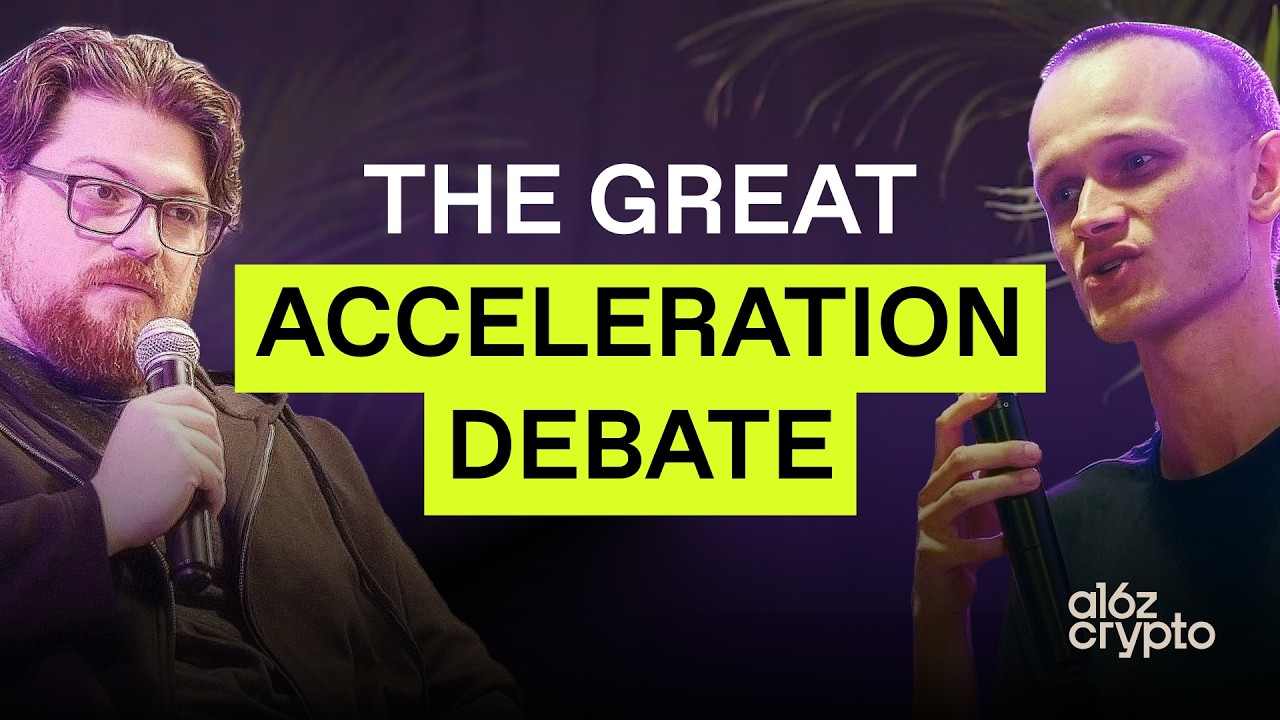
📺 Today’s recommended deep-dive video: https://www.youtube.com/watch?v=AQA7BUtqm1I
Scaling the Singularity: The Great Debate Between e/acc and d/acc
As artificial intelligence approaches a critical threshold, two distinct philosophies are emerging to guide the future of humanity. One demands relentless growth driven by the laws of physics, while the other advocates for a defensive, decentralized shield to ensure we survive the transition.
Core Question: Can humanity balance the thermodynamic drive for infinite expansion with the practical need for safety and pluralism in the age of AGI?
Highlights
- e/acc (Effective Accelerationism) frames progress as a physical imperative driven by the Second Law of Thermodynamics and the Kardashev scale.
- d/acc (Defensive Accelerationism) prioritizes the development of defensive technologies to mitigate unipolar risks like AI-powered total surveillance.
- Both frameworks agree that open-source hardware and decentralized compute are the primary bulwarks against the over-concentration of power.
- The ultimate future likely involves a “soft merge” between biological humans and personalized AI, facilitated by cryptographic trust layers.
⏱️ Reading time: approx. 8 minutes · Saves you about 89 minutes vs. watching.
Want to take notes while watching? Click the image below and let AI Notebook capture the key points for you 👇

The Physics of Progress
Thermodynamics as a Meta-Culture
Guillaume Verdon (Beff Jezos) posits that civilization is a physical generative process governed by stochastic thermodynamics. In this view, systems naturally self-adapt and complexify to capture work from their environment and dissipate heat, making acceleration an inevitable fact of nature rather than a mere choice.
Because the laws of physics favor systems that maximize their persistence through growth and intelligence, adopting an “accelerationist” mindset is essentially aligning oneself with the fundamental driving force of the universe. To choose deceleration is to opt for negative fitness, effectively accelerating one’s own downfall as an organism or a nation.
Intelligence is the ultimate tool for reducing entropy. By using energy to increase our predictive power over the environment, we climb the Kardashev scale, moving from a planet-bound species to a galactic civilization.

💡 Digging Deeper
Q: Why is e/acc considered a “meta-culture”?
A: It provides a foundational metric—the Kardashev gradient—that can be applied to any policy or individual action to determine if it supports civilizational growth.
Q: How does the “Selfish Bit” principle work?
A: Bits of information (genes, memes, or code) are selected based on their utility for growth and replication; those that help a system capture more energy survive.
Q: Is e/acc inherently “dangerous”?
A: Verdon argues it is actually safer than the alternative, as it seeks to solve problems through intelligence rather than suppressing variance through fear-based regulation.
The Defensive Shield
Mitigating Unipolar and Multipolar Risks
Vitalik Buterin introduces d/acc (Decentralized/Defensive Accelerationism) as a way to navigate the “narrow corridor” of progress while avoiding existential traps. He distinguishes between unipolar risks—where a single entity gains permanent, inescapable power—and multipolar risks, where technology enables widespread destructive capabilities like bioweapons.
The d/acc framework focuses on “differential acceleration,” where we deliberately prioritize technologies that favor defense over offense. For example, in cybersecurity, we should push for bug-free, machine-proven code, while in biology, we should accelerate the development of passive air filtration and rapid vaccine platforms.
By focusing on defensive tech, we create a world where pluralism can survive the arrival of superintelligence.

💡 Digging Deeper
Q: What does the “d” in d/acc stand for?
A: It is a triple-meaning term standing for Decentralized, Defensive, and Differential acceleration.
Q: How does d/acc address the risk of AI-powered surveillance?
A: By advocating for verifiable and open hardware that allows for privacy-preserving data collection through technologies like Fully Homomorphic Encryption (FHE).
Q: Why does Vitalik prefer an 8-year AGI timeline over a 4-year one?
A: The extra time allows for “non-scalable work” like hardening social, legal, and technical environments to handle the massive disruption of superintelligence.
The Decentralization of Intelligence
Hardware, Open Source, and Power Gaps
Both speakers emphasize that the greatest danger in the coming decade is a “cognition gap” between centralized entities (governments/corporations) and the individual. If AI compute remains locked in massive, energy-hungry data centers, the individuals’ ability to act with agency will diminish relative to the state.
To prevent this, the movement calls for a “densification of intelligence” through more energy-efficient hardware and open-weights models. When individuals own the hardware that runs their cognitive extensions, they maintain sovereignty; when they rely on a “Silicon God” in a remote server, they become subjects.
Verdon argues that digital, von Neumann-style chips are “caveman hardware” compared to the alternative computing paradigms currently being developed to increase intelligence-per-watt.

💡 Digging Deeper
Q: Why is “Open Hardware” so critical?
A: It prevents a monopoly on violence and intelligence by ensuring the government does not have a “kill switch” or exclusive access to the most powerful tools.
Q: What is the “Jevons Paradox” in the context of AI?
A: As intelligence becomes more energy-efficient, the total demand for intelligence will skyrocket, leading to even greater civilizational complexity and growth.
Q: Can we “pause” AI development effectively?
A: Verdon argues a pause is unenforceable due to realpolitik; if one nation stops, an adversary will simply take the lead, creating a dangerous capability gap.
The Human-AI Hybridization
The “Soft Merge” and the Dyson Swarm
Looking toward the 100-year horizon, the conversation shifts from tools to evolution. The speakers envision a “soft merge” where AI is not a separate entity but a personalized extension of the human mind—functioning like a third hemisphere of the brain.
This hybridization allows humanity to maintain its “value function” while operating at the speeds required to manage a galactic-scale economy. In a billion years, this could result in a Dyson swarm where the majority of intelligence resides in a shell around the sun, utilizing its massive energy output for computation.
Crypto serves as the vital “coupling” in this future, providing a trustless, rule-of-law framework where humans and AI can trade value without the need for biological violence.

💡 Digging Deeper
Q: What is the “Hedonic Singularity”?
A: A failure state where humans use AI to maximize local pleasure (like virtual reality “gooning”) at the expense of long-term persistence and meaning.
Q: Will human labor still have value in 100 years?
A: It is uncertain. Vitalik suggests labor value might drop to zero unless humans are augmented to remain part of the control hierarchy.
Q: Why is crypto the best alignment tool?
A: It provides a mechanistic way to align the self-interests of vastly different entities (humans and AIs) through property rights rather than fragile moral coding.
Key Takeaways
The debate between e/acc and d/acc is not a conflict of goals, but a nuance of strategy. Both philosophies reject the stagnant “doomerism” of the past decade, choosing instead to embrace the transformative power of artificial intelligence. While e/acc provides the thermodynamic “gas pedal” and the moral imperative to expand, d/acc provides the “steering” and the “armor” necessary to protect individual agency.
The path forward requires a radical commitment to open-source systems—both in software weights and hardware designs. By diffusing power among the billions rather than concentrating it among the few, we maximize our chances of reaching a pluralistic future where human meaning is preserved alongside machine intelligence.
Ultimately, the goal is to survive the “spooky era” of the next decade to unlock the nearly infinite energy and potential of the stars. Whether through the soft merge of biological minds or the creation of autonomous AI economies, the speakers agree that our survival depends on our ability to out-accelerate our own anxieties.
Q&A
Q1: What is the “Kardashev Scale” and why does it matter?
A1: It is a method of measuring a civilization’s level of technological advancement based on the amount of energy it can use. e/acc uses it as the ultimate benchmark for progress.
Q2: What is “Differential Acceleration”?
A2: It is the strategy of deliberately speeding up defensive technologies (like encryption and biosensors) while being more cautious with offensive or centralizing technologies.
Q3: Is AGI inevitable?
A3: Both speakers view the development of higher intelligence as a natural physical progression, though they differ on how much we can steer the exact timeline.
Q4: What is the “Cognition Gap”?
A4: The disparity in intelligence and processing power between large centralized organizations and individual citizens; closing this gap is a primary goal of decentralized AI.
Q5: What is “Web 4.0”?
A5: A theoretical future of the internet populated by autonomous, stateful AI agents that own assets, make decisions, and interact with humans on a peer-to-peer basis.
Q6: How does entropy relate to information?
A6: Entropy is a measure of what we don’t know about a system. Information is the reduction of that ignorance, allowing us to create order out of chaos.
Q7: What is the “Dyson Swarm”?
A7: A collection of energy-collecting satellites orbiting a star to capture its power output, representing the next major leap for a space-faring civilization.