📺 Today’s recommended deep-dive video: https://www.youtube.com/watch?v=Jk9ENZywY4A
The Urban Hick’s Guide to Global Finance: Lloyd Blankfein on Risk, Wealth, and the Lessons of History
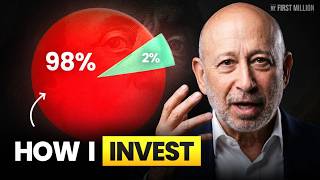
Lloyd Blankfein rose from the Brooklyn projects to the pinnacle of Goldman Sachs, yet he insists that the gap between a “genius” and a failure is often just a single stroke of luck. In this candid conversation, the former CEO pulls back the curtain on his aggressive 98% equity portfolio, the raw insecurity of high achievers, and why he still watches commercials on Netflix despite his net worth.
Core Question: How does a legendary banker manage personal risk, view historical cycles, and maintain the mindset required to survive the world’s most stressful financial storms?
Highlights
- The “Handshake Economy”: Inside the $5 billion deal with Warren Buffett that relied more on reputation than paperwork.
- 98% Equities: Why Blankfein remains heavily invested in tech and energy, treating the market like background music.
- The Resilience Factor: The single trait that separates elite traders from those who wash out.
- The Distant Mirror: Why reading 14th-century history is the best way to understand modern economic volatility.
⏱️ Reading time: approx. 8 minutes · Saves you about 50 minutes vs. watching.
Want to take notes while watching? Click the image below and let AI Notebook capture the key points for you 👇

The Psychology of the Project Mindset
Insecurity as a Feature, Not a Bug
The difference between a superstar and a failure is often a razor-thin margin, similar to a golf tournament won by a single stroke. Blankfein argues that most people in high office are surprisingly normal, driven by the same insecurities and family struggles as everyone else.
He describes himself as an “urban hick” from East New York who didn’t fly on an airplane until after college. Even after decades of leading one of the world’s most powerful institutions, he admits he is still trapped in the mindset of the kid from the projects, unable to even comfortably say the word “rich.”
Luck plays a disproportionate role in determining who reaches the top. Blankfein points out that he became CEO of Goldman Sachs primarily because his predecessor was appointed to the Treasury; had that timing shifted by five years, he might have been considered “too old” for the role. High performance requires talent, but it is the collision of preparation and historical fortune that creates a legacy.

💡 Digging Deeper
Q: Are the world’s most powerful leaders actually geniuses?
A: Very few. Most high achievers are essentially “normal” people with high horsepower who are driven by a need for affirmation and a constant sense of insecurity.
Q: What makes a trader truly elite?
A: Resiliency. The best traders aren’t those who never lose, but those who can look at new information without being paralyzed by past mistakes and adapt their position instantly.
Risk Management and the “Music” of the Market
The 98% Equity Portfolio
While many financial advisors suggest shifting toward bonds as one ages, Blankfein remains 98% invested in risky assets, specifically equities. He views his personal trading as a hobby, a form of intellectual “background music” that requires constant discipline to ignore while engaging in other tasks.
His strategy is heavily weighted toward “hyperscalers”—large-cap tech companies like Google, Microsoft, and Nvidia—along with a significant background in energy and financial services. He admits to missing “more stuff than I got,” including early opportunities in cellular technology because he couldn’t imagine people wanting to carry bulky phones when phone booths were everywhere.
The transition from “aggressive” to “conservative” is often just another word for “conserving” what you already have. Blankfein warns that if you legislate all risk out of a system to prevent the 100-year storm, you effectively kill the 99 years of growth that happen in between.

💡 Digging Deeper
Q: Why does he still watch commercials on Netflix?
A: Old habits from a childhood of scarcity die hard; he still “quibbles” over small costs even when the math of his life says it’s irrelevant.
Q: What was the essence of the Warren Buffett deal during the financial crisis?
A: It wasn’t about the money—Goldman had the cash. It was about buying “world confidence” through the reputation of a man who didn’t even need a written contract to commit $5 billion.
History as the Ultimate Trading Tool
Rhyming through the Centuries
Blankfein encourages traders to study history because it “rhymes” even if it doesn’t repeat. He cites Barbara Tuchman’s A Distant Mirror, which examines the 14th century—a time of plague, war, and papal schism—as a reflection of the stresses and fatalism of the 20th and 21st centuries.
Reading history provides the perspective that current “unprecedented” crises have occurred before and have been overcome. Whether it is the McCarthy era, the Civil War, or the turmoil of the late 1960s, the American experiment has a history of self-correction that should discourage betting against the country.
History also teaches us about the complexity of human achievement. Blankfein notes his evolving view of Robert Moses, the “Power Broker” of New York; as a young man, he saw only the flaws, but after 40 years of trying to get things done, he gained a deeper appreciation for the sheer degree of difficulty involved in building something lasting.

💡 Digging Deeper
Q: Why is the American Revolution a “spiritual” thing for him?
A: Because it created a “self-amending” system that allows for growth and correction, attracting immigrants who understand the value of capitalism better than those born into it.
Q: How does he view philanthropy and inheritance?
A: He believes in giving with a “warm hand” rather than a “cold hand” (giving while alive) and feels a responsibility to provide a “dignified” experience for those receiving aid.
Key Takeaways
Success in the highest echelons of finance is less about possessing a unique “genius” and more about the psychological capacity to endure risk and the humility to recognize the role of luck. Blankfein’s journey from the Brooklyn projects to Goldman Sachs serves as a reminder that “the gap between someone who is really good and someone who can’t make it is not that great.”
The most critical asset for an investor or a leader is perspective. By studying history and recognizing that “nobody knows anything” for certain, one can navigate volatility without being paralyzed by fear. Whether it’s a handshake deal with Warren Buffett or a pivot in a tech position, the ability to bounce back—resiliency—remains the ultimate differentiator.
Finally, wealth does not necessarily overwrite one’s origin story. The “scarring” effects of a childhood where money was scarce can lead to a lifetime of high-performance anxiety. Rather than suppressing this, Blankfein suggests leaning into it as a tool for risk management, provided you have a supportive partner to help “look around corners.”
Q&A
Q1: What is the specific breakdown of Lloyd Blankfein’s portfolio?
A: Approximately 98% is in risky assets (mostly equities). Of that, about 90% is in single stocks and 10% in ETFs. He focuses heavily on tech hyperscalers, energy, and financial services.
Q2: How does he stay informed about the markets daily?
A: He reads the New York Post, Wall Street Journal, Financial Times, and Bloomberg. He also spends much of his day texting and calling a network of people to “gossip” about business stories and market movements.
Q3: What was the “handshake deal” mentioned in the talk?
A: During the 2008 crisis, Warren Buffett committed $5 billion to Goldman Sachs. When Blankfein offered to show him the “worries” or due diligence, Buffett declined, saying he knew Blankfein worried enough for both of them, and he didn’t even require a written contract for certain commitments.
Q4: What is his advice for young investors?
A: Stay in risky assets like equities rather than fixed income. Young people have the time to “outlive their mistakes,” whereas older investors should focus on “conserving” what they have.
Q5: What is the “warm hand vs. cold hand” philosophy?
A: It is the idea that it is better to give away your wealth while you are alive (warm hand) so you can see the impact and joy it brings, rather than waiting until you are dead (cold hand).
Q6: Why does he tell traders to study history instead of just finance?
A: History shows patterns and “rhymes.” Understanding how the world survived the 14th-century plague or the American Revolution provides the mental fortitude to handle modern economic downturns.
Q7: How did his experience at Harvard change his perspective on giving?
A: As a student with only $11 left, he was given a $500 check by a financial aid clerk with no questions asked. The “generosity of spirit” and dignity in that moment shaped his lifelong approach to philanthropy.