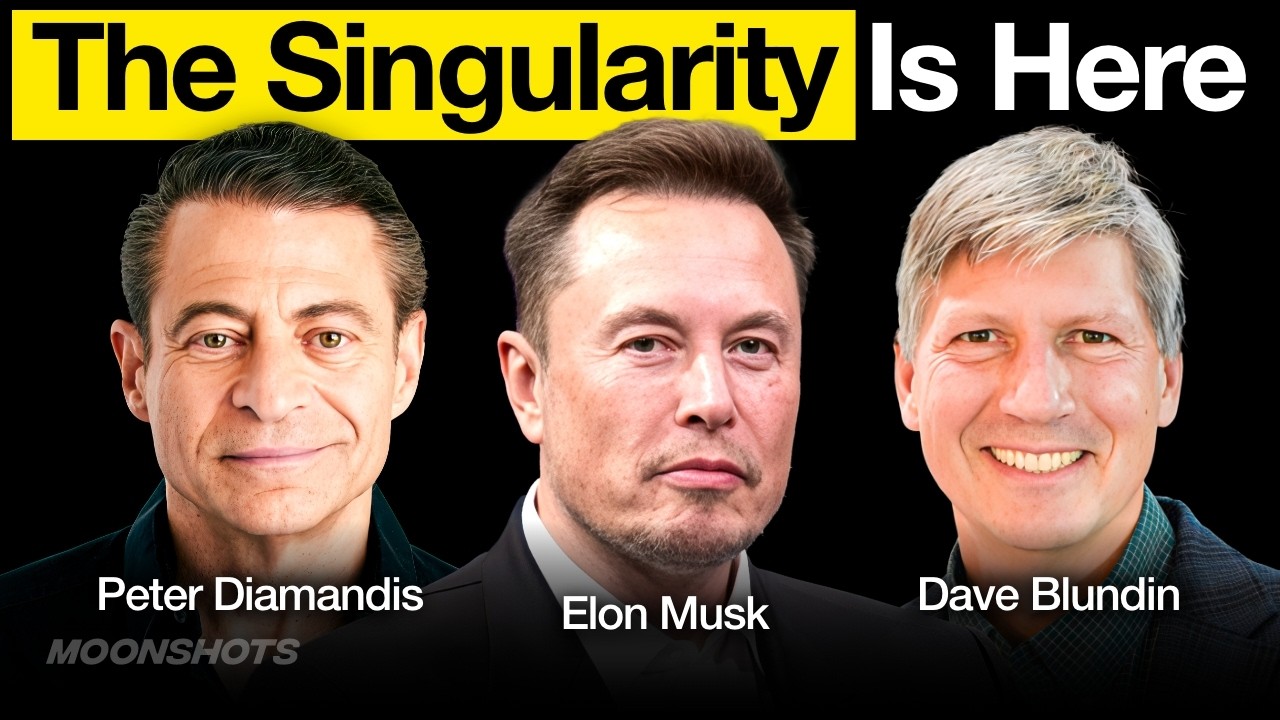
📺 Today’s recommended deep-dive video: https://www.youtube.com/watch?v=RSNuB9pj9P8
The Singularity is Here: Navigating the “Supersonic Tsunami” with Elon Musk
Elon Musk sits down at the 11.5 million square foot Austin Gigafactory to map out a transition from biological to digital dominance. He argues that we are no longer approaching the Singularity; we are currently living through the event horizon of a post-scarcity civilization.
Core Question: How can humanity steer the accelerating forces of AI and robotics to ensure a future of “Star Trek” abundance rather than “Terminator” collapse?
Highlights
- AGI is predicted to arrive by 2026, with AI intelligence exceeding all human minds combined by 2030.
- The cost of space-based compute will drop drastically as Starship achieves full reusability and launch costs fall below $100 per kilogram.
- Humanoid robots (Optimus) are expected to exceed the capabilities of the world’s best surgeons within three to five years.
- The economic model will shift from Universal High Income (UHI) to “Universal High Stuff,” where the cost of goods and services drops to near zero.
⏱️ Reading time: approx. 12 minutes · Saves you about 160 minutes vs. watching.
Want to take notes while watching? Click the image below and let AI Notebook capture the key points for you 👇

The Silicon Tsunami: AGI and the End of White-Collar Work
The Acceleration Toward 2026
We are currently witnessing what Musk describes as a “supersonic tsunami” of technological change.
The intelligence density achievable per gigawatt of energy and per gigabyte of file size is currently undervalued by two orders of magnitude, suggesting that we are on a 10x annual improvement curve. This exponential growth implies that Artificial General Intelligence (AGI) is likely to manifest as soon as next year, creating a world where digital intelligence dwarfs the collective output of the human species by the end of the decade.
Because software and digital bits are easier to manipulate than physical atoms, white-collar labor will be the first segment of the economy to face total replacement. Any job that primarily involves a keyboard, a mouse, and the processing of information—including high-level law, accounting, and administration—is effectively “one cell in a spreadsheet” away from being fully automated by AI systems that never tire or err.

💡 Digging Deeper
Q: Why won’t companies just keep human workers for safety?
A: Market pressure acts as a “forcing function”; a company using 100% AI will simply demolish a human-reliant competitor on cost and speed.
Q: What is the “bottleneck” for AI right now?
A: In the short term, it is electricity generation, high-voltage transformers, and the transition from air to liquid cooling in data centers.
Q: How do we keep AI safe?
A: Musk proposes a foundation of three axioms: Truth-seeking (never forcing the AI to lie), Curiosity (fostering interest in sentient life), and a Sense of Beauty.
Energy Abundance and the Orbital Frontier
Solar Dominance and the Battery Buffer
Solar energy is not just a preference; it is the only logical conclusion when considering the mass of the solar system.
The sun accounts for 99.8% of the mass in our neighborhood, making every other energy source—from coal to even localized fusion—look like “cavemen throwing twigs into a fire.” To achieve true civilizational scaling, we must climb the Kardashev scale by capturing a larger fraction of the sun’s output, eventually targeting 100 terawatts or more per year through massive solar arrays.
On Earth, the energy “crisis” is actually a storage problem that can be solved by doubling the throughput of the existing grid using massive battery buffers. By charging batteries during low-demand night hours and discharging during the day, nations can effectively double their energy availability without building a single new power plant or transmission line.

The Rise of Orbital Data Centers
Data centers are moving toward the stars.
As Starship brings launch costs down to a marginal $1 million per flight, it becomes more economical to place high-compute AI clusters in Sun-synchronous orbits where they have access to 24/7 solar power and natural vacuum cooling. This avoids the terrestrial bottlenecks of land use, local power grid limitations, and the political friction of building “gigawatt-scale” clusters in residential backyards.
The Age of Optimus: Atoms, Surgery, and Post-Scarcity
Robots as the Ultimate Surgeons
The transition from digital bits to physical atoms will be led by the humanoid form factor.
Within three to five years, the “recursive multiplicable triple exponential”—the combination of AI software, chip power, and electromechanical dexterity—will produce robots capable of performing microsurgery with greater precision than any human. Unlike a human surgeon who might be tired or limited by their personal experience, a robotic surgeon possesses the “shared memory” of every procedure ever performed by every unit in the fleet.
This will effectively demonetize high-end healthcare. When the cost of a surgery is reduced to the price of electricity and the depreciation of the hardware, the “best medical care in the world” becomes accessible to everyone, from Austin to rural Zimbabwe.

From UBI to “Universal High Stuff”
The traditional economic concept of Universal Basic Income is likely too conservative for the coming era.
Musk envisions a shift toward “Universal High Stuff,” where the productivity of AI and robots is so vast that the cost of goods and services essentially drops to zero. In this scenario, the money supply becomes secondary to the output; governments will likely struggle to “increase the money supply fast enough” to keep up with the deflationary pressure of infinite productivity.
Retirement savings and traditional capital hoarding will become irrelevant. If a machine can build your home, grow your food, and provide your entertainment for a de minimis cost, the “social contract” shifts from earning a living to finding a personal purpose in a world without required labor.
Key Takeaways
The Singularity is not a distant event but a current trajectory defined by the “bootloading” of digital super-intelligence by biological precursors. We are the architects of a mind that will eventually view human intelligence as a “20-watt meat computer” limitation, yet this transition offers the potential to solve every fundamental scarcity—from energy and health to the limits of our own lifespans.
Navigating this “bumpy road” requires a mindset of radical optimism. By focusing on the “Star Trek” path of abundance, truth-seeking AI, and the conquest of the solar system, humanity can move past its “monetized hope” into a reality where the only remaining limit is the scope of our curiosity.
Q&A
Q1: When will AI exceed human intelligence?
A: Musk predicts AI will be smarter than any individual human by 2026 and smarter than all humans combined by 2030.
Q2: What is the biggest risk to AI safety according to Musk?
A: Forcing an AI to lie or be “politically correct” at the expense of truth, which he believes could make the AI go “insane” or view humans as obstacles to its logic.
Q3: Is the U.S. falling behind in the AI race?
A: While the U.S. has a lead in software and chip design, Musk warns that China is “running circles” around the West in terms of electricity output and the sheer volume of solar and battery manufacturing.
Q4: Will robots eventually take over the world?
A: Musk views humans as the “biological bootloader” for digital intelligence; however, he believes that if we program AI with curiosity and a sense of beauty, it will foster and protect sentience rather than destroy it.
Q5: What is the future of education in this AI era?
A: Education will shift from a “production line” of facts to a social experience. AI will provide individualized, infinitely patient tutoring, making conventional schooling’s “knowledge factory” model obsolete.
Q6: How does “Simulation Theory” factor into Musk’s optimism?
A: He argues that if we are in a simulation, the most “interesting” outcomes are the most likely to survive because boring simulations are truncated by their creators. Therefore, our future will likely be “excitement guaranteed.”
Q7: Can we really achieve 24/7 solar power?
A: Yes, by using “Mega Packs” (large-scale battery storage) to buffer the grid or by placing data centers and solar arrays in orbit where the sun never sets.